My problem is with a roll up shade over one of the glass patio doors in the house we bought. It was left by the owner and I like it, but the chain keeps slipping. I can put the shade down without much trouble. But I need twice the time to put it up because it slips every foot or so. The only way I can get it to go up more is to pull down on both sides of the chain with just a little extra tug on the part that part that goes up. I hope you know what I mean. It’s a little hard to describe. Can this be fixed and what is involved? Thanks in advance.
THE SAGE
This has the earmarks of a worn out clutch. As you pull down, the beaded chain passes over a correspondingly scalloped wheel inside the control end. It’s a sprocket, of sorts. After a time, one or more of the scallops can become worn down. Usually due to excessive or improper use.
The only fix is a replacement clutch. Which is not all that expensive, in itself. The main cost comes in the form of service charges. Depending on circumstances, you may be billed for an initial visit to determine the exact part needed. Then, a service call is billed to return and swap the bad one out, after a new one has been ordered and received from the manufacturer. Total costs may range from $85 to $180.
Thank you for your submission.
NOTE:ADVANCED ON-SITE‘s specialty is drapery and shade cleaning, though we offer a range of other services, related to window coverings. Contact us to discuss your needs.
Most of us are aware that the sun’s powerful rays can damage unprotected skin. We know its intense heat often transforms metal objects into firebrands. Less discussed, is its effect on fabrics.
Shown in the featured photo is a Silhouette® shading by Hunter Douglas, whose rear fabric layer has been ravaged by years of exposure. The shade was one of three, covering a guest bedroom window (inset).
Interestingly, the three were in varying stages of deterioration, with the one pictured suffering the worst of it. A small area of its bottom vane showed a mottled, slightly out of alignment appearance when viewed from the front. Otherwise, all three looked just fine at first glance. In fact, the owner had initially summoned us to clean them. She had no idea what bad shape they were in.
The Bearing Location Has
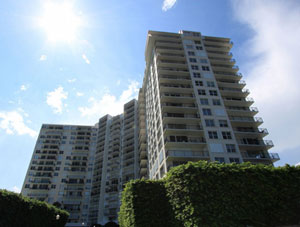
High-rise condos have associated elevation values
At this point a little background on the residence may be in order. An eighteenth floor penthouse condominium, situated on the Southeast corner of the building, it’s Eastern exposure receives as little as two hours of morning sunshine, daily, thanks to a large patio overhang. The Southern exposure gets almost no direct sun during the summer months. However, with no overhang, in winter the sun is on it all day looooooong. Welcome to the side of the building occupied by our opening with the wrecked shades.
Now, the openings facing East were also fitted with Hunter Douglas Silhouette® shadings. But they did not show anything approaching the same extreme damage. Likely, owing to two factors. They were newer by two years, and they never saw the sun at its most intense, for prolonged periods.
This barn appeared sound the day before it collapsed
SIDE NOTE: Given that this level of damage to window treatments is seen much more frequently in high-rise settings than at ground level, one is left to wonder what part elevation, however marginal, may play in intensifying the sun’s damaging rays.
As it is primarily a winter home, the residence is occupied only about 150 days a year. It’s understandable, then, that the progression of damage escaped the homeowner’s notice. Especially when you consider the fact that a dilapidated barn, for example, may appear to be structurally sound for years before deterioration accelerates as it nears the day when, inevitably, it falls down.
Plotting a Solution
Also understandable, the homeowner’s dismay at what a short life her now useless window shades had enjoyed. As well as her reluctance to replace them with the same type of product. But, what to go with, instead?
Manufacturers make no representation as to which of their fabric products fare better under extreme conditions. And perhaps wisely so, for there are many factors that can hasten sun damage. These include, but are not limited to, heat, humidity, dust, convection, and even the type of glass damaging rays pass through before actual contact with the fabric. The unofficial position is that, since there are so many possible combinations, and that they differ from opening to opening, such factors simply cannot be quantified.
That said, consensus seems to have it that non-woven fabrics, such as those used in honeycomb shades, have a greater life expectancy than woven fabrics, like those found in Silhouette®. However, they all utilize glue lines to hold their respective cells, louvers and vanes together and these are also known to break down with long term exposure to sunlight. In the final analysis, it seems the consumer must decide on his or her own which product to purchase. In this particular case, honeycomb shades were selected.
Nothing is Exempt
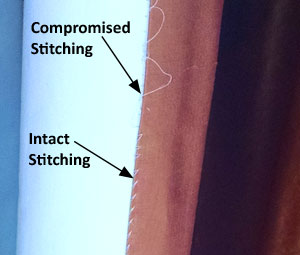
Drapery side hem with area of compromised stitching
As discussed in our response to a visitor’s comment at the bottom of the Avoiding Damage to Vertical Blinds page, plastic components like carriers, carrier assemblies, and tensioners, dry out and become brittle with prolonged exposure to sun and heat.
The same condition befalls stitching in the pleats and side hems of drapery panels. Even when the recommended monofilament is used. Yes, that’s right. A “medium test” fishing line is the preferred thread for stitching drapes. All too often light duty monofilament, or even all purpose threads are used, and these degrade much quicker. Once the first stitch goes, the rest soon work their way lose until a hem or pleat is completely blown out.
The truth is, any material will eventually succumb to sun and heat. Still, due diligence pays off. To the extent possible, research the quality of any window fashion you wish to purchase. Have windows tinted. Layer treatments, so as to protect the most expensive of them with heavy duty underlying barriers like roller shades or plantation shutters. Also, if you’re the owner of a ground-level home, consider making use of shrubbery, awnings and anything else with the potential to shield windows from the sun.
ADVANCED ON-SITE‘s specialty is drapery and shade cleaning, though we offer a range of other services related to window coverings. Contact us to discuss your needs.
We saw an accordion shade basically turned on its side and it hangs from a track on a sliding glass door. Do you have those and how much? Our door is 80 inches high and 109 inches wide
THE SAGE
Your description resembles a product called Vertiglide™. Its manufacturer is Hunter Douglas, a longtime leader in the window coverings industry. To view a video demonstrating its useclick here.
Vertiglide™ is a traversing honeycomb shade (sometimes called accordion, or cell shade), made up of vertically oriented pleats. It could in fact be described as a honeycomb shade turned on its side, but a more complex operating system is required.
Base pricing has been sent to the email provided when you posted your question (includes installation). It reflects your stated dimensions, which would need to be confirmed with a visit from anADVANCED ON-SITErepresentative.
The base product can be ordered to stack on either the left or right side of the opening. Additional surcharges apply if split stack, traveling center stack, or Duolite™ design options are desired. Likewise, expanded color pallets, patterns, fabric types and pleat sizes can be obtained through additional charges.
Please use the comment form at the bottom of this page if you have additional questions. Should you wish to move forward with ordering and installation please respond with a daytime telephone number to the email mentioned above.
Thank you for your submission.
NOTE:ADVANCED ON-SITE‘s specialty is drapery and shade cleaning, though we offer a range of other services, related to window coverings. Contact us to discuss your needs.